Double effect
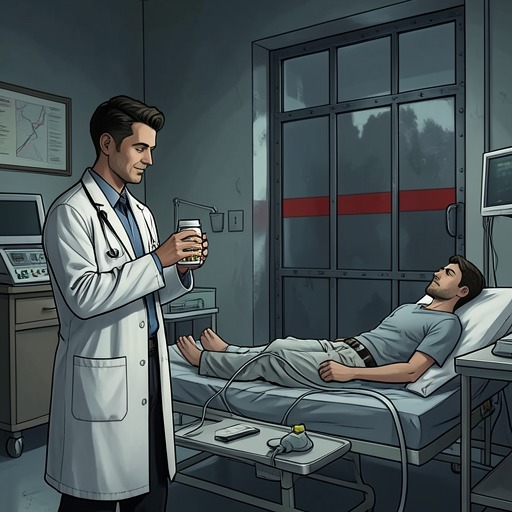
Five Days at MemorialDouble effect is the ethical distinction between intending to relieve a patient’s suffering and foreseeing that the treatment may also hasten death. At Memorial Medical Center during Hurricane Katrina, the distinction became difficult to separate from decisions about evacuation, staff exhaustion, and the care of critically ill patients. The account places the principle not in the abstract but in a contested clinical judgment: Ewing Cook knew that Morphine could suppress breathing, and his decision to increase it for Jannie Burgess was later described by Cook himself as hastening her death.
Definition and Clinical Use
Morphine was used to control severe pain or discomfort, but it could also slow a patient’s breathing. A substantial increase in dosage could therefore have a foreseeable life-shortening effect. Clinicians experienced in end-of-life care could regard that danger as limited when the drug was properly administered; Cook, however, considered the separation between palliation and prematurely causing death far less secure.
Cook’s usual practice gave the distinction a specific clinical context. When a gravely ill patient or the patient’s family chose to discontinue a ventilator, he might prescribe Morphine to prevent the patient from gasping as mechanical breathing support was withdrawn. The purpose was comfort, even though the amount needed could markedly suppress respiration and thereby hasten death. In this account, the ethical question turns not only on a drug’s known effects, but also on what the clinician intends and the circumstances in which it is given.
Burgess and the Evacuation Crisis
Burgess was comatose, had received occasional pain medication, and appeared comfortable when Cook examined her. She was also severely burdened by fluid associated with her illnesses. Cook thought it would be impossible to carry her down six flights of stairs, doubted that he could climb back to the intensive-care unit, and judged that she might have only about a day to live. He also believed the nurses caring for her were needed elsewhere. These considerations shaped the decision, but they did not make Burgess’s case identical to the ventilator-withdrawal situations in which Cook ordinarily used Morphine for comfort: she did not appear to be in distress at the time.
Cook asked Burgess’s nurse to increase the Morphine enough for her to die. He then made an entry in her chart stating that she had no respirations or cardiac activity, left the time of death blank, and signed the note before returning downstairs. He later called his decision an obvious one, but also acknowledged that he had given her medicine to get her off the floor sooner and release the nurses from their post. He explicitly conceded that he had hastened her death. His account therefore does not present a simple instance in which an unintended harm merely accompanies a comfort-directed intervention: it records both his concern about suffering during a possible move and his stated desire to expedite her death and free staff.
The broader evacuation policy adds another ethical distinction. Memorial’s doctors had decided that patients with Do-not-resuscitate (DNR) orders would be evacuated last, although a DNR order meant that a patient should not be revived if breathing or heartbeat stopped; it was not, by itself, a request to forgo rescue. Jannie Burgess was among four DNR patients in the intensive-care unit. Elsewhere in the hospital, a patient’s daughter sought to cancel her mother’s DNR order after realizing that staff were treating it as a reason not to evacuate her. That episode makes clear how a medical instruction with a limited meaning could acquire much broader consequences in the emergency. It is part of the setting in which decisions about treatment, rescue, and the value of time became entangled, but it does not by itself establish what any individual intended when administering medication.
Evidence and the Limits of Toxicology
The later investigation raised a related but distinct problem: detecting a drug is not the same as proving how it caused a death, when it was administered, or what the person administering it intended. Bodies recovered after more than a week in the heat could not yield usable blood samples for checking drug levels. Investigators were told that drugs might nevertheless leave traces in more resilient tissues, including liver, brain, and muscle, and in fluid that pooled in the abdomen. Testing of eighteen Memorial bodies found Morphine in nine and Midazolam in several others. Those findings prompted further scrutiny, but the available evidence did not make every step from exposure to cause of death or criminal intent self-evident.
When experts reviewed the results, they considered each patient’s medical history alongside the laboratory numbers. They asked whether the concentrations might reflect a single large dose shortly before death or repeated doses accumulating in patients whose kidney or liver disease affected drug processing; whether the medication combination was contraindicated for particular patients; and whether the drugs’ effects on breathing and blood pressure fit the recorded circumstances and timing of death. The review treated the toxicology as evidence requiring interpretation, not as a stand-alone verdict.
The experts also disagreed about how much could be inferred from decomposed tissue. Steven Karch argued that heat exposure made it impossible to determine the medical causes of death and recommended leaving them undetermined. Michael Baden countered that uncertainty about the precise dose did not erase evidence that Morphine and Versed had been present shortly before death, while Cyril Wecht maintained that some measured levels were exceptionally high and described a small, unpublished comparison study of drug levels in heated and refrigerated samples. The disagreement matters to the concept because toxicology can inform questions about exposure and possible medical effects, while intention and the ethical or legal character of an act require additional evidence.
Ethical Significance
Double effect clarifies why a foreseeable risk does not automatically settle the moral meaning of treatment: an intervention intended to relieve suffering may carry a serious risk of shortening life. But the principle does not remove the need to examine the patient’s actual condition, the purpose and circumstances of the treatment, and what the clinician understood about its effects. In Burgess’s case, Cook’s own retrospective statement complicates any account that would describe the decision solely as symptom relief. At the same time, the contested postmortem evidence cannot, by itself, resolve every question about dosage, causation, or intention.
The book thus presents the principle as a boundary under pressure rather than a ready-made answer. In ordinary end-of-life care, Cook described using Morphine to ease the withdrawal of ventilator support; during the evacuation crisis, his decision concerning Burgess was made amid severe logistical constraints and an admitted wish to hasten events. The contrast exposes what the ethical distinction can illuminate—and what it cannot decide without careful attention to the particulars of a patient’s care and the evidence surrounding a death.